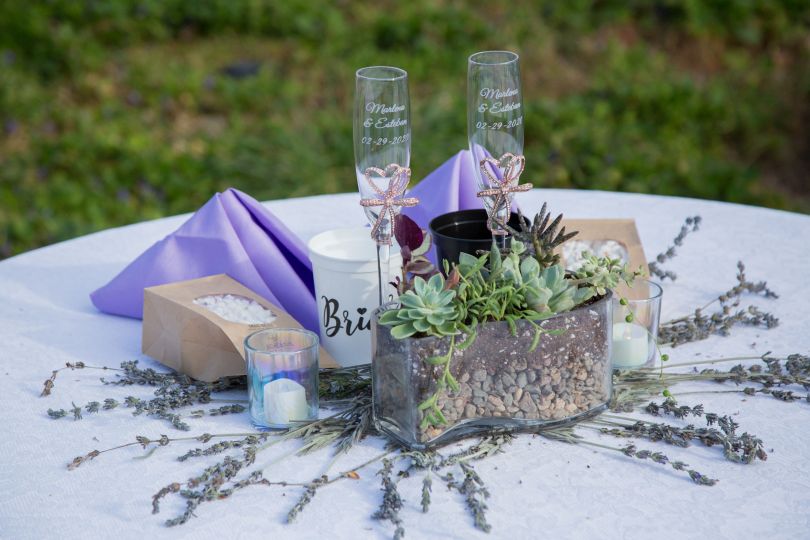
A round table decorated with dried lavender flowers, a succulent arrangement, tealights, glass champagne flutes, and lavender napkins.

Making it through one year of marriage in a pandemic

As March approaches, the world is marking one year of being in a pandemic, and I am marking one year of marriage. My partner and I became husband and wife on February 29, 2020; a gorgeous, sunny day on which we were able to gather under the sky with our friends and family to celebrate. While we’ve been together for 8 years now, this last year – our first married, spent almost entirely in a pandemic, has been both one of the most challenging and the most enriching.

To be completely honest, there were times when I wondered if we would make it. Yes, I loved this man enough to want to spend my life with him, but did I love him enough to spend all day, every day, confined to our house together, for an indefinite amount of time? I wasn’t sure. Pandemic life isn’t the life that any of us signed up for. And living together, when you each have your own work schedules and routines and lives that take place away from home, is much different from living together when you both work and sleep and eat and recreate in the same 1000 or so square feet. When, if you leave the house and spend time around other people, you’re risking your life and/or the lives of the people around you.

We have made it, so far. I know this pandemic life isn’t nearly over, but I’m pretty proud of how we have grown in love and in life through this past year. I know that it’s an unpopular opinion for me, as a millennial cis-woman, to be happily married, to a millennial cis-man. So many articles and even recent Twitter threads have shown that married cis-women in heterosexual relationships are having a horrible time right now. Cis-men have been happy to sit back and allow their cis-women partners to take on the majority of the cleaning, cooking, child-rearing responsibilities, even when they don’t work as much, or at all.

While my husband isn’t perfect (nobody is, perfection is a myth rooted in white supremacy), he at least understands the importance of cleaning up after yourself and sharing the responsibilities of nourishing and maintaining a household. Pre-pandemic, my husband would wake up every weekday, get ready for work, make coffee, sometimes a smoothie, occasionally boil a few eggs, and grab the dinner leftovers that he had packed for lunch before leaving to work for the day. I would eat whatever I wanted for breakfast as I started my work day at home (I’ve worked from home for nearly 4 years now), heat up leftovers, or make a salad or a sandwich for lunch, and cook dinner throughout the week. I washed whatever dishes I used during the day, and my partner usually cleaned up after dinner. It felt easy, fair, and I love to cook, so being mainly responsible for the main meal of the day was no problem.

When the pandemic began, and my husband started working from home as well, things changed. He struggled with work-life balance before, and when the line between work and home became completely blurred, that balance was non-existent. His morning routine changed from getting up, getting ready, and helping with breakfast, to getting up, walking to his desk in our second bedroom, and starting his work day. At first he marveled at the fact that not needing to commute meant he could spend more time working. He is a mortgage loan originator, and with record low interest rates on mortgages, he has had plenty of work to do and could easily work 60+ hours per week. I, in our honeymoon phase in the first several weeks of the pandemic, was okay with making breakfast and lunch and taking it to him at his desk – for a time. Fairly quickly, though, I realized that if I didn’t have time to make coffee, or breakfast, or lunch – he wouldn’t. There were multiple days where I would just grab something quick and eat at my desk, and he wouldn’t eat anything at all until 1:00 or 2:00 pm.

What had felt like an evenly shared responsibility before, had become entirely my responsibility – to figure out what the heck to eat 3 times a day, 7 days a week. Every week. I found myself doing 100% of the cooking, but also washing about 50% of the dishes. By mid-summer we came up with a solution. My husband found an affordable, local, meal prep service, and suggested we order meals to make this task a little easier. I was reluctant at first, but the meals were decent and I relented to the fact that it is okay to accept help, especially in the middle of a pandemic. We began ordering 8 meals per week from them, taking the place of 4 lunches and/or dinners. When I say affordable, I mean affordable, like $50 – $60 per week for the meals, which cut our grocery bill in half to $45 – $50 per week. My husband makes coffee and a smoothie, boiled eggs, or toast for breakfast, we take turns making/heating up lunch throughout the week, and I cook dinner two to three days during the week. We support local restaurants on the weekends, and spend some time meal prepping together on Sundays. I take care of the breakfast and lunch dishes, and he takes care of the dinner dishes. All of this has helped this task return to being a shared responsibility. It’s also helped us eat healthier meals, makes keeping the kitchen clean relatively painless, and prevents arguments rooted in unspoken resentment about who’s not carrying their weight.

Cooking and dishes aren’t the only things that became challenging, of course. Having no alone time has been difficult for me, a super introvert who needs to spend a lot of time just doing my own thing. Not being able to hang out with friends (without risking our lives or the lives of those around us) has been difficult for my husband, a super social ambivert who has a very close group of friends, who are like family. So I manufacture alone time while he manufactures connection. Specifically, he got a PlayStation and started playing Call of Duty online with his friends on the TV in our second bedroom. He works way more hours than I do, so I get enough time to myself throughout the week, and on weekends I am perfectly happy with him playing video games for a few hours while I watch my shows or listen to podcasts or write or read or do a home organizing project.

Making intentional time to be present together has been essential as well. From taking our fur-child Bernie on walks together every afternoon during the week, without phones, to finding ways to spend time together beyond watching TV or cleaning. We’ve worked on puzzles together, played a conversation card game, or two-person board games like Scrabble and Rummikub. On the weekends, our pandemic-friendly outings consist of picking a park to drive to for a walk or a hike, occasionally picking up takeout to eat at the park. Even making the bed together in the morning, or playing with Bernie before we go to bed at night, have been opportunities for us to have quality time even when we are around each other all of the time. We still watch TV together, of course, we are millennials and I truly enjoy film and television as art forms, but making time to spend engaging with just each other has helped us continue to communicate, get to know each other, and deepen our bond.

It was also important for us to have some conversations we hadn’t had before, even in 7+ years of being in relationship with one another. Binding ourselves together legally and financially required us to have frank conversations about how we manage our income, how much debt we had, our expenses, what our financial goals are. Early in April we sat down and talked through what we wanted to accomplish in the next few years, ensuring we were clear on how we wanted to be in partnership with each other, and what it would take from both of us to get there. And we’ve continued to have those conversations, as the need to make financial decisions and choices has come up. Knowing that we’re aligned here has helped to alleviate stress when the possibility of layoffs came up at work, and as we’ve dreamed together about where we want our careers to go in the next few years.

Then there were the conversations about racism and white supremacy that happened in many households beginning last summer. I have been thinking and talking about dismantling white supremacy for several years, and dragging my husband along the way. But the movement for Black lives and against police brutality, and the campaign of the former president of the U.S., provided so many more opportunities for both of us to confront the ways in which we’ve benefited from white privilege, and how we were operating in ways that were “not racist”, and not antiracist. These have been some of the most tense moments, when I realized that, while we had been having conversations here and there, it was as though we had been speaking different languages.

While I had been listening to podcasts, reading, and learning through Diversity, Equity, and Inclusiveness work at my job over the last 3+ years, he was mostly living life in the oblivious way that many not-racist white men do. This movement for racial equity forced us to get on the same page about needing to be actively antiracist, about how we must dismantle the beliefs rooted in white supremacy culture within ourselves, how to support each other in doing so in productive ways, and provided the opportunity for us to get clear on how, if we have them, we intend to raise our children. It was difficult at first, heartbreaking at moments, but eventually we arrived at a place where we recognized how much there remains for each of us to learn, and concluded that we must do it together. When he started questioning why I was watching The Crown (“isn’t this white supremacy?”), I realized this is both a blessing and a curse.

And through it all, therapy. Phone appointments with my therapist help me get out of my head for a bit, and learning how to manage my anxiety in healthier ways has helped me improve immensely at communicating my needs, understanding what is at the root of my reactions, and inviting my partner in on my healing. It has even helped him understand more about the ways in which he needs to heal as well.

Of course, I must recognize how much privilege is present here. We are both employed, in jobs that pay a comfortable living wage and allow us to work from the safety of our home. We do not have children, and I firmly believe that having access to contraception and reproductive healthcare, in a country without universal healthcare, is a privilege. Having access to therapy is also a privilege. Not having any underlying conditions, and not being within a demographic that puts us at greater risk in this pandemic, are privileges. Even living near enough to relatives to have been able to see family a handful of times over the course of the year feels like a privilege right now. While several people close to us have gotten sick with COVID-19, some of them incredibly so, not one of the over 500,000 individuals who have lost their lives to this virus in the U.S. has been someone who we have had to mourn.

It certainly hasn’t been easy, but having a caring and loving partner who is ready and willing to grow with me has kept me going over this last year. As we approach our wedding anniversary, I am filled with joy and gratitude at having chosen this incredible person to spend my life with, and filled with excitement for the dreams that we’ve been dreaming together. While I look forward to the days when we can enjoy fulfilling social lives once again, I have truly cherished this opportunity to spend time learning how to love one another even more fully.
One year of COVID-19 in my community

It has been 366 days since the first case of COVID-19 was identified in my community. The evening of January 26, 2020, Arizona State University confirmed that the first case of the novel coronavirus detected in Arizona was within the university community – a student on the Tempe campus, and they were quick to assure the community that the student had not been in university housing, and was in isolation.

I saw this news on Twitter late that night, and as I went to bed I thought about all of the people who had been on the flight that brought that student to Phoenix, I thought of the potential Uber or Lyft driver who picked them up from the airport, I thought of the potential people at the grocery stores, restaurants, and other places where that student had been before they knew they were carrying the virus. The university announcement had indicated that they were working with the Maricopa County Department of Public Health to complete contact tracing, and that individuals who may have been exposed would be contacted. But what about all of the people anonymous to that student who could have been exposed?

The morning of January 27th, I woke up thinking about this. I turned to my then-fiance, now husband, and told him – coronavirus is here. I had that day off of work, and as I drove around town running errands, I found myself at a red light behind a sports car, with a license plate that was 5 letters: WUHAN. Having attended ASU, and having lived within a handful of miles from ASU’s Tempe campus for most of the last 8 years, I know that there is a large community of international students drawn to Tempe for and by the university, and I am used to seeing the flashy sports cars of the wealthiest among those students around town. In that moment it struck me – they identified one case, but there were surely others who had been going about their lives after returning from their holiday travels.

It was easy enough to brush aside that thought as anxiety, and move forward through my day in the carefree way we used to before the pandemic began in earnest. That evening, I gathered with my family at a restaurant to celebrate my grandma’s birthday. As we sat around the table, the fact that she would be 75 in 2021 came up. We talked briefly about where we should go on a trip to celebrate, as some of us had gone to Hawaii to celebrate her 70th birthday. A conversation that I’m sure we all forgot about within the next couple of months.

Less than two weeks later, on February 8th, I was preparing for my first flight of the year, a trip to New York City for work. That weekend I spent a few hours searching for face masks. I went to CVS, Walgreens, Target, and checked Safeway on Instacart. They were sold out everywhere. I thought I was being paranoid, but as I was preparing to get married at the end of February, I was trying to avoid catching anything and getting sick period. Arriving at JFK, I remember seeing a couple of people wearing masks. I moved about the city as I had on previous trips, sharing space and air with countless strangers, and returned to Phoenix a few days later.

Another work trip to Los Angeles, wedding prep, a whole 200+ person wedding, and a couple of Spring Training games came between that trip and COVID-19 being declared a global pandemic. My husband and I hung out with friends the weekend of March 13th. That was also the weekend that the yoga studio I had been going to for the last 6 months emailed to say they were closing at the end of the month, that, “with the current state of affairs (i.e., public health concerns, etc.),” they simply would not be able to continue operating. On Saturday my husband and I went out with friends for one last night of drinks and dancing on Mill Ave., realizing that we were maybe getting too old for this, not realizing that it would be our last time for over a year. That night I looked around at the packed sidewalks, the full bars and dance floors and thought – “we shouldn’t be here.” I figured there must be at least 50, likely more, people moving around Mill Ave. that night unknowingly spreading the virus. The following day I went grocery shopping, only to find many of the shelves and produce bins at my local Sprouts bare. I had to make a separate trip to my carniceria to find onions. Even there, the one small section of fideo, estrellitas, and conchitas was nearly empty. I watched videos of people fighting over toilet paper at Costco and joked, “that’s just Sunday at Costco.”

On March 17th, my husband received confirmation from his employer that he would be working from home beginning the following week. That was also the day that the first person in Arizona confirmed to have died from COVID-19 passed. That week I watched for packages containing his new work from home equipment, while the number of people in Arizona feeling symptoms, somehow finding a COVID-19 test and testing positive jumped from 16 to 53 overnight. I saw social media posts about cancelled weddings and other large gatherings, about sports events and conferences being cancelled. I thought of the tens of thousands of people from all over the country who had just been traveling through Phoenix, who were still at that moment in Phoenix, for a Spring Training season that had just gotten started and was already over. I thought of my family members who had recently returned home to California, after attending some of the Spring Training games that had managed to not be rained out. I think it was around this time that the reality of the likelihood of exposure hit me, that it began to feel like even just going to the grocery store was risky, and seeing loved ones without quarantining or being tested felt like a gamble. The reality of living in a pandemic had set in.

I stopped leaving the house except for a daily walk with my husband and our dog, grocery shopping, and picking up food. During this period I decided to prepare myself for what was to come, by watching the American Experience episode on the 1918 flu pandemic, and reading an article by a former professor about how it impacted Phoenix. I was rocked by the knowledge I took away from this afternoon, when I learned that this would not be a simple couple of months being unable to safely gather with loved ones, or be around strangers, but potentially a couple of years.

On March 30th I felt overwhelmed with all sorts of emotions as I listed to Governor Doug Ducey announce the “Stay Home. Stay Healthy. Stay Connected.” order, asking Arizonans to limit their time away from home. In the same conference where he announced this order, he encouraged Arizonans to go outside, to go golfing, to take advantage of the beautiful weather. At this point, nearly 200 cases were being identified per day, and 20 Arizonans were confirmed to have passed away from COVID-19.

March turned into April. I began checking the Arizona Department of Health Services COVID-19 Data Dashboard frequently, watching the case numbers continue to go up despite the order. When I was leaving the house at this point, I was still maskless like most others. I didn’t have a mask, and if the stores were sold out in early February, they were certainly sold out then. Then the CDC recommended that everybody wear masks, and posted instructions for how to make one yourself at home. I fashioned a couple out of an old tank top, one of my dog’s bandanas, some rubber bands and tea filters. Still, when I went to the store or to pick up food, most people weren’t wearing masks. I didn’t think the makeshifts masks looked that bad, but I was getting strange looks from people at the breakfast burrito spot and in the grocery store. I was incredibly happy when my husband’s aunt sent us some cloth masks in the mail.

The stay home order was nearly over and cases continued to rise. I began searching for testing, and saw that it was mostly limited to people who were essential workers, or who had underlying conditions. Even though cases were still rising, and there wasn’t nearly enough access to testing, Gov. Ducey decided to end the order on May 15th. By this time the Navajo Nation had emerged as a hotspot, with rates higher than New York and New Jersey. 651 Arizonans were confirmed to have died from COVID-19, and 578 people tested positive that day. The mask “debate” provided an easy way to determine someone’s political beliefs, or at the very least their commitment to community. I was incredibly saddened to go by one of our favorite bagel shops for breakfast one weekend, only to find that they were not requiring customers nor employees to wear masks. I haven’t been back since.

One month later, on June 15th, 2,999 people tested positive, and 1,194 Arizonans had passed. Arizona had emerged, for the first but not the last time, as the COVID-19 hotspot of the country. The sound of sirens became a near constant as the case count curved exponentially upward. Two days later Governor Ducey issued another order, allowing city governments to implement face covering ordinances if they wanted to, an action he had explicitly blocked with a previous executive order. The city ordinances came swiftly, and pretty soon mask mandates were in place all over the Phoenix metro area. It still took some time for the case numbers to level out and begin to decline.

In late June, a close friend tested positive, just a couple of days after going golfing with my husband. Our friend became incredibly sick and ended up being admitted to the hospital, and I tried desperately to find tests for me and my husband. Just over a week after he had been exposed, I got appointments for tests at an urgent care. Mine was first, and after waiting nearly an hour to be called back into the exam room, I was administered a test, and then told by a Physician’s Assistant that, because I was not yet showing symptoms, they weren’t going to send the test into the lab. She said that there weren’t enough resources to test everybody who wanted to be tested, even though they had just wasted the resources they used on me. In the midst of this first peak in infections and deaths, testing was still so inaccessible. It wasn’t until the first week of July, after free 24-hour COVID testing sites had opened up around the valley, that I was able to get us tested. We had passed the 14-day window of exposure at that point, but I just wanted to be sure. We went for tests on July 7th, and were told it would be a 3 – 5 day turnaround time. We didn’t get our results until 13 days later, on July 20th. I went almost immediately to spend an afternoon with my grandma.

Finally new case numbers were on the decline by early August. While still higher than they were during the stay home order, they were much lower than the summer spike of 3,000+, 4,000+ cases confirmed every day. I relaxed my personally imposed restrictions a bit, went on a road trip Airbnb vacation with my husband, went camping with my extended family members. Still, the numbers were higher than they were during the stay home order. Still, at least 10 – 20 Arizonans were dying from COVID-19 every day.

By late October cases and deaths were on the rise again. After the holidays, Arizona quickly became a hot spot once again, and we have remained at or near the top of charts tracking new infections per capita. The number of daily new cases eclipsed the summer peaks before Thanksgiving, and records were broken over and over leading up to and then following Christmas.

And now it’s been a year. A week ago, 7,262 Arizonans tested positive for COVID-19. 12,448 Arizonans have died from COVID-19, and nearly 15,000 more Arizonans died of all causes in 2020 than in 2019, a 23% increase in mortality in the state. There are no more appointments for vaccines, and individuals who got one dose might not even be able to get the second. But you can get a haircut, you can go eat inside of a restaurant, you can go to the gym. And the bars and sidewalks on Mill Ave. are busy every weekend.